Udawalawe Safari Animals: Complete Wildlife Guide & What to See

The animals of Udawalawe National Park represent one of Sri Lanka's most impressive wildlife assemblages, creating a biodiverse ecosystem that rivals many of Africa's famous savanna parks. While the park's Asian elephant population of 500-600 individuals rightfully claims the spotlight as the main attraction, Udawalawe's 30,821 hectares of protected habitat support an extraordinary variety of mammals, over 210 bird species, numerous reptiles, and countless invertebrates creating a complete, functioning dry zone ecosystem. The park's open grassland terrain, permanent water sources, and varied habitats ranging from reservoir wetlands to forest patches provide niches supporting wildlife diversity that surprises many first-time visitors expecting only elephants. Understanding what animals you can see at Udawalawe enhances your safari experience by helping you identify different species, appreciate behavioral observations, recognize rare or significant sightings, and understand the ecological relationships connecting these diverse creatures into integrated communities. This comprehensive wildlife guide explores every major animal group you might encounter during your Udawalawe safari—from the magnificent elephants and impressive water buffalo to colorful endemic birds, basking crocodiles, and elusive nocturnal mammals. We'll cover identification features distinguishing similar species, behavioral patterns revealing when and where to spot different animals, fascinating ecological facts about Udawalawe's wildlife, and photography tips for capturing each species effectively during your Sri Lankan safari adventure.
Asian Elephants: The Kings of Udawalawe
Population and Demographics
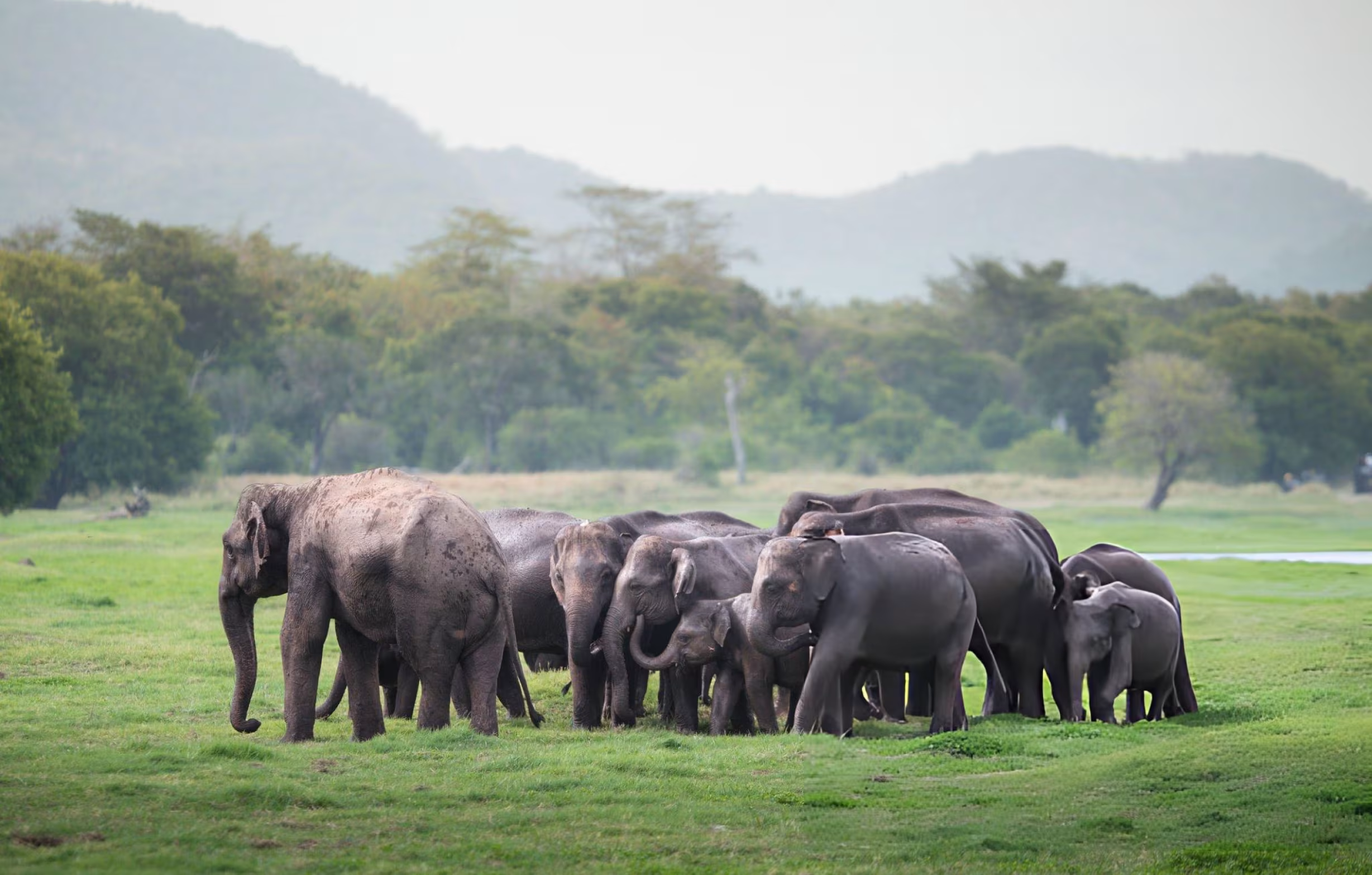
Udawalawe's elephant population numbers approximately 500-600 individuals, making it one of Sri Lanka's largest and most stable elephant herds. Unlike elephant populations in seasonal parks that migrate between reserves throughout the year, Udawalawe's elephants are predominantly resident, establishing territories entirely within park boundaries and remaining year-round thanks to permanent water and food availability.
Age structure within the population spans the full spectrum from newborn calves (occasionally just days or weeks old) to ancient matriarchs exceeding 60 years. This demographic diversity indicates a healthy, reproducing population rather than a declining herd consisting primarily of aging individuals. The presence of numerous calves and juveniles demonstrates successful breeding, while elderly elephants provide crucial knowledge and leadership maintaining social structures.

Sex ratio favors females as typical in elephant populations, with family herds dominated by related females while most adult males live independently or in bachelor groups. This sexual segregation reflects elephant social organization where females maintain lifelong family bonds while males leave their birth herds upon reaching adolescence (typically 12-15 years old).
Individual variation among Udawalawe's elephants becomes apparent with close observation. Some individuals possess impressive tusks (both males and females in Asian elephants, though many females and some males are tuskless), others show distinctive ear tears or notches from old injuries or fights, and certain elephants display characteristic body builds, gaits, or behaviors that experienced guides recognize, sometimes even naming particularly notable individuals.
Physical Characteristics and Identification
Size differences between Asian and African elephants help identify species for first-time viewers. Asian elephants like those at Udawalawe are smaller than African savanna elephants (though larger than African forest elephants), with adult males reaching 2.5-3 meters shoulder height and 4,000-5,000 kg weight, while females measure 2-2.5 meters tall and 2,500-3,500 kg. By comparison, African savanna elephants reach 3-4 meters and 6,000-7,000 kg, though the size difference isn't always obvious without direct comparison.
Ear size provides the most obvious visual distinction—Asian elephants have much smaller ears shaped somewhat like the Indian subcontinent, while African elephants sport enormous ears shaped like the African continent. The smaller ears reflect Asian elephants' forest-adapted origins where large ears would snag on vegetation, versus African elephants' savanna evolution where large ears aid cooling in open, hot environments.
Trunk features include a single finger-like projection at the trunk tip (Asian) versus two projections (African), though this subtle difference requires close observation. Asian elephants also display a slightly arched or level back profile compared to African elephants' noticeably swayed backs.
Tusk variation among Udawalawe's elephants ranges from impressive ivory tusks in some individuals to complete tusklessness in others. Among Asian elephants, many females naturally lack visible tusks (possessing only small tushes hidden by the trunk), while males more commonly display tusks though even among males, tuskless individuals (makhnas) appear regularly. Tusk presence, size, and configuration help guides identify specific individuals.

Social Structure and Behavior
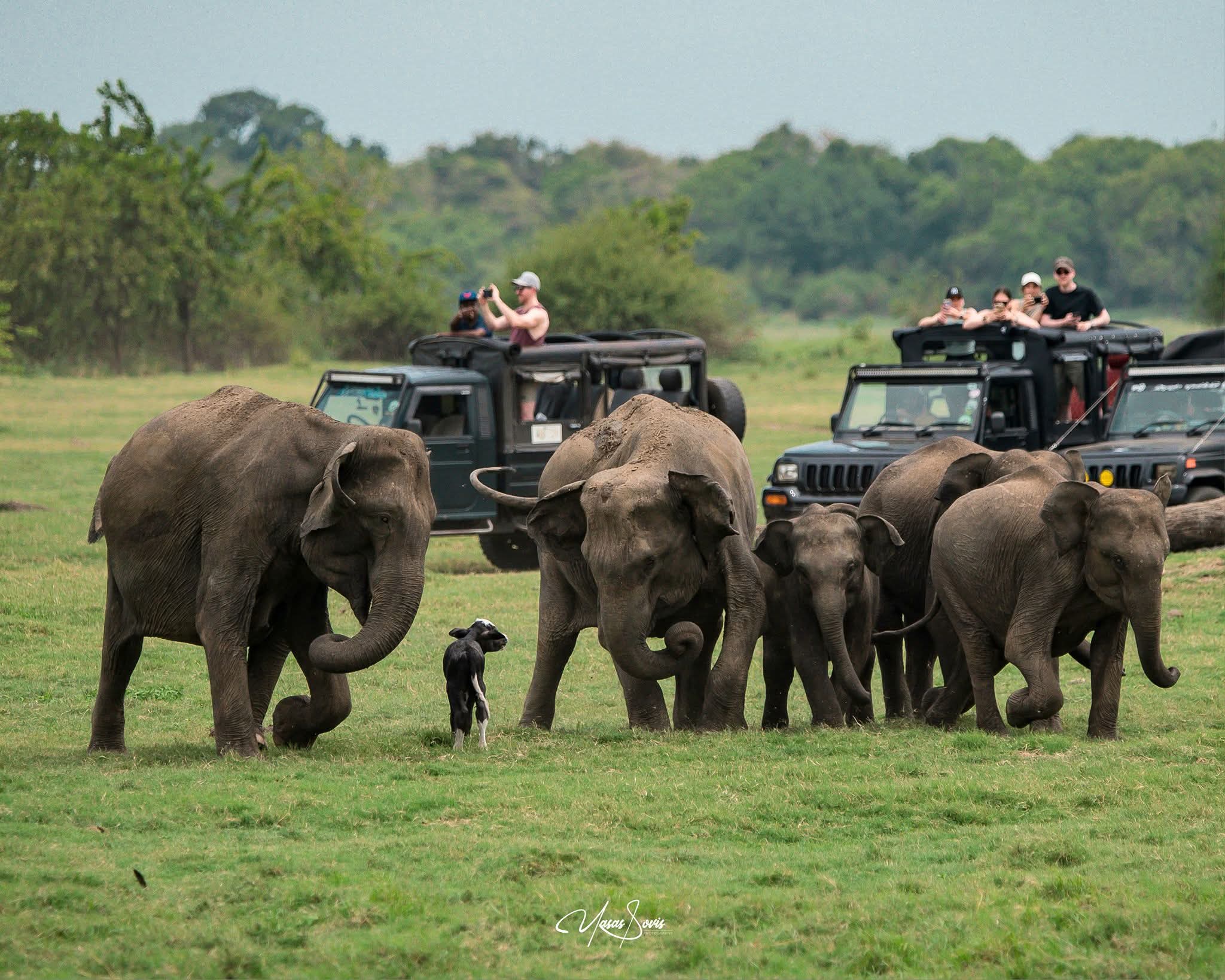
Matriarchal family herds form the foundation of elephant society. These groups consist of 8-20 (sometimes more) related females spanning multiple generations—grandmothers, mothers, daughters, sisters, aunts—and their immature offspring of both sexes. The eldest, most experienced female (the matriarch) leads the herd, making critical decisions about movement routes, feeding locations, water visits, and threat responses based on decades of accumulated knowledge.
Herd dynamics visible during Udawalawe safaris include coordinated movement with adults surrounding and protecting younger, more vulnerable members; cooperative calf rearing where multiple females assist with supervision and teaching; communication through vocalizations ranging from subsonic rumbles to trumpeting calls; and greeting ceremonies when separated individuals reunite, involving trunk intertwining, temporal gland secretions, and excited vocalizations.
Bachelor groups consist of young to middle-aged males who've left their birth herds but haven't yet achieved the size, age, and dominance to live completely independently. These fluid groups have loose membership with individuals coming and going. Bachelor elephants engage in extensive play-fighting, practicing the sparring and dominance assessment skills they'll need when competing for breeding opportunities as fully mature bulls.
Solitary bulls include older, more dominant males who've established their position in the male hierarchy and prefer independent living. These impressive elephants appear alone or temporarily associate with female herds when females are in estrus. The largest, most dominant bulls typically enjoy priority breeding access, though competition from younger rivals increases as bulls age beyond their prime (typically after age 40-45).
Musth periods create dramatic behavioral changes in adult males. Musth, a hormonal condition causing testosterone levels to spike up to 60 times normal, renders bulls highly aggressive, sexually motivated, and unpredictable. Musth bulls display characteristic signs including dark temporal gland secretions streaming down the face, continuous urine dribbling, distinctive high-headed posture, and heightened aggression toward other males and even humans. Even dominant bulls typically avoid musth males due to their extreme aggression and lack of normal inhibitions.
Daily Activity Patterns
Morning activity (6:00-10:00 AM) sees elephants emerging from overnight forest shelters to feed actively on grasslands during cooler temperatures. Family herds often move together in coordinated groups, traveling from forest shade to open feeding areas. This period produces some of safari's most photogenic moments as elephants backlit by morning sun graze peacefully or move across landscapes in impressive processions.
Reservoir visits peak during mid-morning and late afternoon when herds converge at water's edge for drinking after several hours of feeding. Bathing behavior intensifies as temperatures rise—elephants wade into deeper water, spray themselves thoroughly using their trunks, submerge partially, and roll luxuriously in cooling mud. Calves particularly enjoy water play, splashing energetically while mothers supervise watchfully.
Midday rest (10:00 AM - 2:00 PM) drives most elephants into forest shade during peak heat. While some individuals continue feeding or bathing, activity levels decrease markedly as elephants prioritize thermoregulation over foraging. Bulls particularly spend extended periods submerged chest-deep in the reservoir, drinking and cooling simultaneously.
Afternoon emergence beginning around 3:00-4:00 PM mirrors morning patterns as elephants leave shade to resume feeding on grasslands. The late afternoon gathering at the reservoir for drinking and bathing often proves even more spectacular than morning sessions, with multiple herds converging simultaneously creating the day's peak concentrations.

Feeding Behavior and Diet
Herbivorous diet consists primarily of grass (50-80% depending on availability), supplemented by browse including leaves, bark, and branches from woody plants. Adult elephants consume 150-200 kilograms of vegetation daily, feeding 16-18 hours to meet their massive nutritional requirements. This constant feeding drives much of their daily movement as elephants must continually relocate to fresh food sources.
Grass preference at Udawalawe capitalizes on extensive grasslands covering much of the park. Elephants graze selectively, using their sensitive trunk tips to pluck preferred grass species and portions while avoiding less palatable plants. Fresh grass shoots emerging along receding reservoir edges prove particularly attractive, drawing concentrated elephant activity to these productive zones.
Browse feeding supplements grass intake and becomes more important during dry season when grassland productivity declines. Elephants strip bark from trees, break branches to access leaves, and consume fruits when available. Their feeding creates substantial environmental impact—"elephant damage" to trees through bark removal and branch breaking is actually an important ecological process creating varied habitat structure.
Salt licking occurs at natural mineral deposits where elephants obtain essential nutrients lacking in vegetation. While less visible than feeding on plants, these mineral sources play critical roles in elephant nutrition and health.
Communication and Intelligence
Vocalizations span a remarkable range from subsonic rumbles below human hearing (traveling several kilometers through ground vibrations elephants detect with their feet and trunk tips) to loud trumpeting audible for kilometers. Contact calls maintain herd cohesion when members separate, greeting rumbles celebrate reunions, and alarm calls warn of threats. Mothers and calves maintain almost constant vocal contact.
Body language communicates intentions, emotions, and social status through posture, ear position, trunk positioning, and movement patterns. Threat displays include head high, ears spread wide, and direct advances; submission involves lowered head and ears laid back; playfulness shows in loose, bouncy movements and trunk waving; and intense interest manifests in frozen stillness with trunk extended testing air currents.
Trunk versatility demonstrates elephants' exceptional intelligence and dexterity. This remarkable appendage functions as nose, hand, arm, snorkel, weapon, tool, and communication device simultaneously. Watch elephants using trunks to drink (drawing water then spraying into mouth), bathe (showering themselves), greet (trunk intertwining), investigate (delicately exploring objects), grab food, discipline calves, and countless other functions showcasing incredible precision control over this 40,000-muscle organ.
Problem-solving abilities and memory become evident in elephants' adaptive behaviors. They remember water source locations decades later, recognize hundreds of individuals, learn from experience, use tools (holding sticks to scratch unreachable spots), and demonstrate self-awareness rare among non-human animals. These cognitive abilities contribute to elephants' complex social lives and survival success.

Large Mammals
Water Buffalo (Bubalus arnee)
Physical characteristics: Massive bovines reaching 900-1,200 kg (males) with powerful build, large splayed hooves adapted for wetlands, curved horns spanning up to 2 meters tip-to-tip, and sparse grey-black hair covering tough skin. Bulls appear larger and darker than females, with more impressive horn development.
Population and distribution: Substantial herds numbering 50-100+ individuals congregate around Udawalawe's wetland areas and reservoir edges. These buffalo represent wild or feral populations rather than domestic animals, displaying natural behaviors and wariness of humans.
Behavior patterns: Highly gregarious with strong herd cohesion, water buffalo spend extensive time wallowing in mud for cooling and parasite control. They're most active during cooler morning and evening hours, often resting in shade or partially submerged in water during midday heat. Bulls can be aggressive particularly during breeding season—maintain respectful distances despite their seemingly docile appearance.
Viewing opportunities: Reliably observed throughout safaris, particularly around wetland areas where they wallow and graze. Large concentrations create impressive photo opportunities, especially when gathered densely in mud pools or drinking at reservoir edges. Their massive size and imposing horns command attention even alongside elephants.
Ecological role: As large herbivores, water buffalo influence grassland structure through grazing and trampling, create wallows used by other species, and serve as prey for larger predators (though adult buffalo are formidable and rarely taken by Sri Lankan wildlife).
Spotted Deer / Chital (Axis axis)
Physical characteristics: Medium-sized deer reaching 90-100 cm shoulder height and 60-90 kg weight. Distinctive white spots covering reddish-brown coat year-round (unlike temperate deer that lose spots as adults), white underparts and inner legs, and males sporting impressive lyre-shaped antlers with typically three tines per beam.
Behavior and social structure: Live in herds segregated by sex outside breeding season—female groups with fawns, bachelor male groups, and solitary territorial males. During rutting season, dominant stags establish territories and gather harems of females. Highly vocal, spotted deer produce distinctive alarm calls warning of predators.
Activity patterns: Most active during cooler dawn and dusk hours, resting in shade during midday. Often graze alongside elephant herds, possibly benefiting from elephants' vigilance and ability to detect threats. Their alarm calls potentially alert other species to danger, creating mutualistic relationships.
Viewing frequency: Very common at Udawalawe, seen regularly during most safaris grazing in open grasslands or forest edges. Their relatively approachable nature and attractive appearance make them excellent photography subjects, particularly impressive stags with full antlers.

Sambar Deer (Rusa unicolor)
Physical characteristics: Sri Lanka's largest deer species reaching 120-140 cm shoulder height and 150-250 kg. Dark brown to grey-brown coat without spots, thick muscular build, and males bearing heavy antlers with typically three tines. Sambar appear more robust and less graceful than spotted deer.
Habitat preferences: Favor forest edges and areas with cover more than open grasslands, though they do emerge to graze in clearings particularly during low-light periods. More secretive than spotted deer, preferring areas with escape cover nearby.
Behavior: Less gregarious than spotted deer, often seen alone or in small groups (3-8 individuals). Females with fawns form small maternal groups while males are typically solitary or form loose bachelor associations. Very alert and wary, sambar detect threats through keen hearing and scenting.
Viewing opportunities: Less commonly observed than spotted deer but regularly encountered during Udawalawe safaris, particularly near forest-grassland boundaries. Impressive stags with large antlers create memorable sightings, though they're warier and require more patient approach.
Wild Boar (Sus scrofa)
Physical characteristics: Stocky, powerfully built pigs reaching 60-90 cm shoulder height and 50-100 kg weight. Coarse grey-black bristly coat, elongated snout, and males developing impressive tusks and shoulder shields. Young show distinctive striped pattern fading as they mature.
Behavior and ecology: Highly adaptable omnivores feeding on roots, tubers, insects, small animals, and carrion uncovered through rooting with powerful snouts. Mostly crepuscular and nocturnal though sometimes active during day in protected areas. Live in sounders (family groups) led by dominant females.
Viewing frequency: Commonly spotted during Udawalawe safaris, particularly in muddy areas where they root for food and wallow for cooling. Often appear near wetlands, forest edges, and areas with disturbed soil. Their active foraging behavior creates entertaining viewing.
Conservation status: Abundant and widespread, wild boar actually thrive in human-modified landscapes making them one of world's most successful large mammals. At Udawalawe they fill ecological roles as seed dispersers, soil disturbers, and prey for larger predators.
Sri Lankan Sloth Bear (Melursus ursinus inornatus)
Physical characteristics: Medium-sized bear reaching 140-190 cm length and 80-145 kg weight. Shaggy black coat with distinctive V or Y-shaped white chest marking, long curved claws adapted for termite feeding, and mobile lips capable of forming tube-like snout for sucking insects.
Population status: Extremely rare at Udawalawe with very occasional sightings. The park lies at the edge of sloth bear range, and their low density plus primarily nocturnal habits make encounters exceptional events rather than expected sightings.
Behavior: Primarily feeds on termites and ants accessed by tearing open mounds with powerful claws, also consumes fruits, honey, and occasionally small animals. Mostly nocturnal in areas with human presence. Mothers carry cubs on their backs when young.
Viewing reality: Don't expect sloth bear sightings—they're extremely uncommon. Any encounter represents extraordinary luck. However, knowing they potentially inhabit the park adds to the wilderness atmosphere and possibility of unexpected discoveries.

Carnivores and Small Mammals
Sri Lankan Leopard (Panthera pardus kotiya)
Physical characteristics: Powerfully built big cat reaching 100-170 cm body length plus 85-110 cm tail, weighing 30-70 kg. Beautiful golden coat covered with distinctive black rosettes, white underparts, and extremely muscular build particularly in shoulders and forelimbs.
Population and sightings: Present at Udawalawe but in very low density with extremely rare sightings. Unlike Yala National Park where leopards achieve high visibility due to exceptional density and open habitat, Udawalawe's leopards remain elusive, primarily nocturnal, and generally avoid areas frequented by safari vehicles.
Behavior and ecology: Solitary apex predator feeding on deer, wild boar, smaller mammals, and occasionally livestock from areas adjacent to park. Highly territorial with males maintaining large ranges overlapping multiple female territories. Primarily nocturnal in areas with human activity.
Viewing expectations: Set realistic expectations—leopard sightings at Udawalawe are exceptional rather than expected. Most visitors completing multiple safaris never see leopards. However, their presence contributes to ecosystem completeness and the possibility, however remote, adds excitement to every safari.
Golden Jackal (Canis aureus)
Physical characteristics: Medium-sized canid resembling a small wolf or large fox, reaching 60-90 cm length and 7-14 kg weight. Golden-brown to grey coat, bushy tail with black tip, pointed muzzle, and relatively short legs. Often mistaken for foxes by inexperienced observers.
Behavior and habits: Omnivorous opportunists feeding on small mammals, birds, reptiles, insects, fruits, and carrion. Often hunt in pairs or small family groups, cooperating to catch prey. Primarily crepuscular and nocturnal though occasionally active during day, particularly early morning and late afternoon.
Viewing frequency: Regularly encountered during Udawalawe safaris, particularly around water sources during dawn and dusk. Their distinctive trotting gait, alert demeanor, and tendency to stop and observe safari vehicles make them entertaining subjects despite being smaller than headline species.
Vocalizations: Famous for howling calls that echo across the landscape particularly during dawn and dusk, creating atmospheric soundtrack to safari experiences. These vocalizations help pairs and family groups coordinate movements and defend territories.
Mongoose Species
Indian Grey Mongoose (Herpestes edwardsii): Most commonly observed mongoose species at Udawalawe, reaching 35-45 cm body length plus long tail. Grey-brown coat, pointed snout, and characteristically alert, quick movements. Diurnal and frequently crosses safari routes darting from cover to cover.
Ruddy Mongoose (Herpestes smithii): Similar size to grey mongoose but with distinctive reddish-brown coat and black tail tip. Somewhat less common than grey mongoose but regularly encountered. Shares similar habitats and behaviors.
Stripe-necked Mongoose (Herpestes vitticollis): Larger than grey mongoose with distinctive dark stripe on neck sides. More restricted to forest edges and areas with denser cover. Less frequently observed during grassland-focused safaris.
Behavior: All mongoose species are active diurnal predators feeding on small mammals, birds, eggs, reptiles (including venomous snakes which they kill through remarkable speed and agility), and invertebrates. Solitary or living in small family groups, they're constantly active, making them entertaining to observe despite small size.

Fishing Cat (Prionailurus viverrinus)
Physical characteristics: Medium-sized wild cat reaching 80-120 cm length including tail, weighing 6-12 kg. Stocky build with short legs, distinctive grey coat with black spots and stripes, partially webbed feet adapted for aquatic hunting, and relatively short tail.
Habitat and behavior: Highly specialized for wetland habitats, fishing cats hunt fish, frogs, crustaceans, and waterbirds along reservoir edges and marshes. Excellent swimmers, they dive for fish and patrol shorelines hunting. Primarily nocturnal and crepuscular.
Conservation status: Vulnerable globally due to wetland habitat loss. Udawalawe's extensive wetlands provide important habitat for this endangered species.
Viewing probability: Extremely rare sightings due to nocturnal habits, wetland habitat often covered with vegetation, and low population density. Most safari visitors never encounter fishing cats, though they're present. Very early morning or late evening safaris in wetland areas offer the best (though still minimal) chances.
Rusty-spotted Cat (Prionailurus rubiginosus)
Physical characteristics: One of world's smallest wild cat species, reaching just 35-48 cm body length and 900-1,600 grams weight. Grey coat covered with rusty-brown spots, proportionally large eyes adapted for nocturnal hunting, and remarkably diminutive size.
Behavior: Primarily nocturnal, hunting small mammals, birds, lizards, and large insects in grasslands and scrub habitats. Remarkably agile climbers despite small size. Solitary and territorial.
Viewing reality: Extremely rare sightings due to tiny size, nocturnal habits, and low density. Any encounter represents exceptional luck. These cats inhabit Udawalawe but remain virtually invisible to safari visitors.
Birds of Udawalawe
Large Water Birds
Painted Stork (Mycteria leucocephala): Large wading bird reaching 93-102 cm height with distinctive pink tertial feathers, yellow bill, and black-banded wings visible in flight. Nests in large colonies in trees near water, creating spectacular breeding aggregations. Very common at Udawalawe, easily observed feeding in shallow water or nesting in trees.
Spot-billed Pelican (Pelecanus philippensis): Large pelican reaching 125-152 cm length with characteristic throat pouch, overall grey-white plumage, and spotted bill. Feeds cooperatively, often in groups that coordinate fishing efforts. Regularly observed at the reservoir, both swimming and loafing on shores.
Asian Openbill (Anastomus oscitans): Medium-sized stork reaching 68-81 cm with distinctive gap between mandibles when bill is closed (hence "openbill"). Grey-white plumage with black wings. Feeds primarily on freshwater snails and mollusks extracted using specialized bill. Common in wetland areas.
Purple Heron (Ardea purpurea): Large heron reaching 78-90 cm with beautiful purple-grey plumage, long neck, and dagger-like bill. More secretive than other herons, often hiding in dense wetland vegetation. Hunts by standing motionless then striking rapidly to capture fish and frogs.
Black-headed Ibis (Threskiornis melanocephalus): White-bodied ibis with black head, neck, and down-curved bill. Reaches 65-76 cm length. Feeds in shallow water and wet grasslands, probing mud for invertebrates. Gregarious, often feeding in flocks with other wetland birds.

Raptors and Birds of Prey
White-bellied Sea Eagle (Haliaeetus leucogaster): Large raptor reaching 70-85 cm with distinctive white head, breast, and underparts contrasting with grey back and black wings. Hunts fish and waterbirds around the reservoir, often perching prominently in tall trees or soaring on broad wings. One of park's most impressive birds.
Crested Serpent Eagle (Spilornis cheela): Medium-sized forest eagle reaching 55-75 cm with distinctive crest, brown plumage with white spots, and yellow eyes. Often perches prominently on tall trees calling loudly. Feeds primarily on snakes, lizards, and other reptiles. Common and easily observed.
Brahminy Kite (Haliastur indus): Beautiful medium-sized raptor reaching 45-51 cm with distinctive chestnut body, white head and breast, and broad wings. Often seen soaring over water or perched near wetlands. Scavenges and hunts small prey including fish, frogs, and insects.
Black Kite (Milvus migrans): Common raptor reaching 50-60 cm with dark brown plumage and distinctive forked tail visible in flight. Highly adaptable scavengers and hunters. Often circle overhead in thermals. Both resident and migratory populations occur.
Changeable Hawk-Eagle (Nisaetus cirrhatus): Impressive forest eagle reaching 60-72 cm with variable plumage (dark and light morphs exist) and prominent crest. Powerful hunter taking birds, small mammals, and reptiles. Less common than other raptors but regularly observed perched in trees or soaring.
Endemic and Specialty Species
Sri Lankan Grey Hornbill (Ocyceros gingalensis): Endemic large bird reaching 45-50 cm with distinctive grey plumage, large curved bill with small casque, and long tail. Very vocal with loud cackling calls. Common in forest edges and wooded areas. Endemic to Sri Lanka.
Ceylon Junglefowl (Gallus lafayettii): Sri Lanka's national bird and wild ancestor of domestic chickens. Males display spectacular red, orange, and purple plumage with distinctive comb and wattles; females show cryptic brown coloration. Males give loud crowing calls. Endemic to Sri Lanka, common in forest understory.
Yellow-fronted Barbet (Psilopogon flavifrons): Small colorful bird reaching 20-22 cm with green body, yellow forehead and throat, and blue face. Very vocal with distinctive loud calls. Feeds on fruits and insects in forest canopy. Endemic to Sri Lanka.
Brown-capped Babbler (Pellorneum fuscocapillus): Small brown bird reaching 15 cm, endemic to Sri Lanka and southern India. Secretive forest floor dweller with loud melodious calls. More often heard than seen in forest undergrowth.
Sri Lankan Woodshrike (Tephrodornis affinis): Small grey and white bird reaching 16 cm. Endemic to Sri Lanka, found in forest edges and open woodlands. Often joins mixed-species foraging flocks.

Migratory Birds (November-March)
Various waterfowl arrive during northern winter including numerous duck species (garganey, northern pintail, northern shoveler, common teal), waders and shorebirds (sandpipers, plovers, stints), and other waterbirds. These migrants join resident populations creating exceptional diversity during wet season months.
Indian Pitta (Pitta brachyura): Spectacular ground-dwelling bird with brilliant blue, green, and red plumage. Winter visitor to Sri Lanka from Indian breeding grounds. Secretive forest floor dweller, more often heard than seen. Highly sought by birdwatchers.
Forest Wagtail (Dendronanthus indicus): Distinctive wagtail with unique side-to-side tail wagging motion. Winter visitor preferring forest floors and edges. Less common than other wagtails but regularly encountered.
Reptiles
Mugger Crocodile (Crocodylus palustris)
Physical characteristics: Large reptilian predator reaching 3-4 meters length (occasionally larger) with powerful build, armored scaly skin, and massive jaws lined with conical teeth. Broad snout distinguishes muggers from gharials and saltwater crocodiles.
Behavior and ecology: Ambush predator feeding on fish, waterbirds, small mammals, and occasionally larger prey including deer that come to drink. Basks extensively on mudbanks for thermoregulation, controlling body temperature through sun exposure. Can move surprisingly fast over short distances both in water and on land.
Viewing opportunities: Frequently observed during Udawalawe safaris basking on reservoir edges, partially submerged in shallow water, or swimming. Dry season concentrates crocodiles on remaining water bodies, improving sighting reliability. Large individuals command respect—maintain safe distances despite them appearing sluggish.
Safety considerations: While dangerous predators, crocodiles pose minimal threat to safari visitors remaining in vehicles. Never approach water edges on foot in crocodile habitat. Crocodiles' presence adds authentic wildness to ecosystem while creating photography opportunities.

Water Monitor (Varanus salvator)
Physical characteristics: Large lizard reaching 1.5-2 meters total length (occasionally larger) with powerful muscular build, long tail used for swimming and defense, sharp claws, and grey-brown coloration with subtle darker banding.
Behavior: Semi-aquatic predator and scavenger feeding on fish, frogs, crustaceans, birds, eggs, small mammals, and carrion. Excellent swimmer, water monitors patrol reservoir edges hunting actively. Also climb trees with surprising agility despite large size.
Viewing frequency: Commonly observed during safaris, particularly around wetland areas. Their active foraging behavior, impressive size, and tolerance of vehicles make them excellent subjects for observation and photography. Often swim across open water or hunt along shorelines.
Ecological role: Important predators and scavengers, water monitors help control prey populations and clean up carrion. Their presence indicates healthy aquatic ecosystem.
Land Monitor (Varanus bengalensis)
Physical characteristics: Similar size to water monitor but with slightly different build and coloration—grey to yellowish-brown with clearer yellow spotting. Prefers drier habitats than water monitor though ranges overlap.
Habitat preferences: More terrestrial than water monitor, favoring grasslands, scrub, and forest edges. Still occasionally enters water. Digs extensive burrow systems for shelter.
Behavior: Diurnal predator feeding on insects, small mammals, birds, eggs, and carrion. More wary than water monitor, often fleeing quickly when disturbed. Excellent climber despite terrestrial habits.
Viewing: Less commonly observed than water monitor but regularly encountered in appropriate habitats. Often crosses roads or hunts in grassland areas.
Sri Lankan Star Tortoise (Geochelone elegans)
Physical characteristics: Beautiful tortoise reaching 15-35 cm shell length with distinctive star-pattern radiating from each shell plate. Yellow stars on dark background create striking appearance. Domed shell provides protection from predators.
Conservation status: Vulnerable due to habitat loss and illegal collection for pet trade. Strictly protected under Sri Lankan law—never attempt to touch, move, or collect these tortoises.
Behavior: Herbivorous, feeding on grasses, leaves, flowers, and fruits. Most active during early morning and late afternoon, sheltering during midday heat. Breeding occurs during monsoon months when food availability peaks.
Viewing: Occasionally encountered crossing roads during safaris, particularly after rains. Patient observers might spot them feeding in grasslands. Their slow movements and beautiful patterns make memorable sightings despite small size compared to elephants.

Snakes
Diversity: Udawalawe harbors numerous snake species though actual sightings during safaris remain relatively uncommon due to snakes' secretive nature and tendency to avoid safari vehicles.
Venomous species potentially present include Indian cobra (Naja naja), Russell's viper (Daboia russelii), common krait (Bungarus caeruleus), and various pit vipers. While dangerous, these snakes avoid human contact and rarely pose threats to visitors following standard safety protocols (staying in vehicles, watching where you step if walking in designated areas).
Non-venomous species include various rat snakes, water snakes, wolf snakes, and other harmless species. These play important ecological roles controlling rodent populations.
Viewing: Snake sightings add excitement to safaris but shouldn't be expected. Most visitors complete safaris without seeing snakes. If encountered, observe from safe distances and never attempt handling—all snakes regardless of species should be treated with respect and caution.
Invertebrates and Other Wildlife
Butterflies
Diversity: Over 50 butterfly species inhabit Udawalawe including common species and occasional rarities. Dry season grasslands attract numerous butterflies feeding on flowers and puddling at wet soil for minerals.
Notable species: Common Mormon, Lime Butterfly, various Blues and Grass Yellows, and during wet season, spectacular Painted Ladies in large numbers. Butterfly diversity peaks during transitions between dry and wet seasons when flowers bloom prolifically.
Viewing: While not primary safari focus, attentive observers enjoy butterfly watching as pleasant addition to larger wildlife viewing. Wet season particularly produces impressive butterfly activity.
Dragonflies and Damselflies
Wetland specialists: The reservoir and associated wetlands support diverse dragonfly and damselfly populations. These aerial predators hunt insects around water bodies creating colorful additions to wetland ecosystems.
Viewing: Common around reservoir edges, particularly during wet season. Their brilliant colors (metallic blues, greens, reds) and aerial acrobatics entertain observers between larger wildlife sightings.
Other Invertebrates
Termites: Multiple species create distinctive mounds throughout the park. These ecosystem engineers process dead plant material, creating soil and providing food for specialized predators like sloth bears.
Dung beetles: Play crucial roles processing elephant and other mammal dung, recycling nutrients and reducing parasite loads. Often visible rolling dung balls across roads.
Spiders: Diverse spider fauna includes impressive golden orb weavers creating large webs, jumping spiders, and countless other species filling ecological niches.
Wildlife Photography Tips by Species
Elephants
Optimal settings: Shutter speed 1/500s or faster to freeze movement, aperture f/5.6-f/8 for depth of field keeping entire elephant sharp while softly blurring background, ISO adjusted for proper exposure (typically 400-1600 depending on light).
Composition techniques: Shoot at elephant eye level when possible rather than looking down from tall vehicles, include environmental context occasionally rather than pure close-ups, wait for behavioral moments (bathing, feeding, social interaction) rather than static portraits, and pay attention to backgrounds avoiding cluttered or distracting elements.
Best lighting: Early morning and late afternoon golden hours provide warm, flattering light with long shadows adding depth. Midday harsh light creates extreme contrast—consider underexposing slightly to preserve highlight detail in bright skin.

Birds
Equipment needs: Longer focal lengths (400mm+) essential for most bird photography due to distance and small subject size. Large water birds allow shorter lenses (200-300mm) when approached closely.
Technical challenges: Fast shutter speeds (1/1000s+) freeze bird movement, continuous autofocus tracks flying or moving subjects, and high ISO may be necessary for sufficient shutter speed particularly in lower light.
Approach strategies: Remain patient allowing birds to habituate to vehicle presence, position vehicle with best light angle (preferably side-lit or back-lit rather than front-lit), and wait for interesting behaviors (feeding, preening, interaction) rather than simple perched portraits.
Mammals Other Than Elephants
Deer photography: Similar settings to elephants but potentially faster shutter speeds (1/800s+) as deer move more quickly and unpredictably. Stags with impressive antlers deserve selective focus on head and antlers.
Predator photography: If fortunate enough to encounter leopards or other carnivores, prioritize any shot over perfect shots—rare sightings justify accepting less-than-optimal images. Use fastest available shutter speeds and continuous shooting mode.
Small mammals: Mongoose and similar small, fast-moving subjects require fast shutter speeds (1/1000s+), careful focus tracking, and burst mode shooting. Their quick movements make single shots challenging.
Conservation Status and Threats
Population Trends
Elephant population: Stable or slowly increasing at Udawalawe thanks to effective protection and good habitat quality. The park's resident population doesn't experience the dramatic fluctuations seen in seasonal migration parks.
Threatened species: Several Udawalawe inhabitants face conservation challenges including fishing cats (Vulnerable globally), rusty-spotted cats (Near Threatened), sloth bears (Vulnerable), star tortoises (Vulnerable), and various endemic birds.
Success stories: Water buffalo, sambar deer, and spotted deer maintain healthy populations thanks to protection. Bird populations remain robust with successful breeding documented for most species.
Conservation Challenges
Human-wildlife conflict: Outside park boundaries, elephants raid crops causing economic hardship for farmers and leading to retaliatory elephant killings. Electric fencing helps but doesn't completely prevent conflict.
Habitat connectivity: Isolation from other protected areas limits genetic exchange and prevents natural population dynamics. Corridor conservation connecting Udawalawe with other elephant habitats represents critical conservation priority.
Climate change: Altered rainfall patterns, extended droughts, and temperature increases potentially stress wildlife populations and alter ecosystem dynamics.
Visitor Roles in Conservation
Responsible viewing: Maintaining appropriate distances, following guide instructions, never feeding wildlife, and reporting unethical operator behaviors all support conservation.
Economic support: Tourism revenue funds park management, ranger salaries, and conservation programs while providing economic incentives for communities to value wildlife.
Awareness: Sharing safari experiences and conservation messages with personal networks raises awareness about Sri Lankan wildlife and conservation challenges, potentially inspiring support for protection efforts.

Final Thoughts: Appreciating Udawalawe's Wildlife Diversity
The animals of Udawalawe National Park create an interconnected ecosystem where elephants attract headline attention while countless other species from tiny damselflies to massive water buffalo fill essential ecological roles. Understanding this diversity transforms safaris from simple elephant-viewing excursions into comprehensive wildlife experiences where every sighting contributes to appreciating the complex web of life sustaining Udawalawe's grasslands and wetlands.
While elephants rightfully dominate most visitors' attention and memories, taking time to observe painted storks building nests, golden jackals trotting purposefully across grasslands, crocodiles basking motionless on mudbanks, spotted deer grazing peacefully alongside elephant herds, and endemic grey hornbills calling from forest edges reveals the richness that makes Udawalawe more than just an "elephant park." It's a functioning ecosystem where predators and prey, herbivores and carnivores, resident species and migrants all interact in patterns refined over millennia.
Approach your Udawalawe safari with eyes open not just to elephants but to all the wildlife sharing their habitat. Ask your guide to identify birds, point out smaller mammals, and explain ecological relationships. These additional layers of understanding enhance appreciation for the complexity and beauty of natural systems while ensuring every safari moment holds potential for discovery and learning. The more you observe, the more you'll see—and the more deeply you'll connect with the magnificent wildlife calling Udawalawe National Park home.