Elephant Gathering at Udawalawe National Park: Sri Lanka's Year-Round Wildlife Spectacle

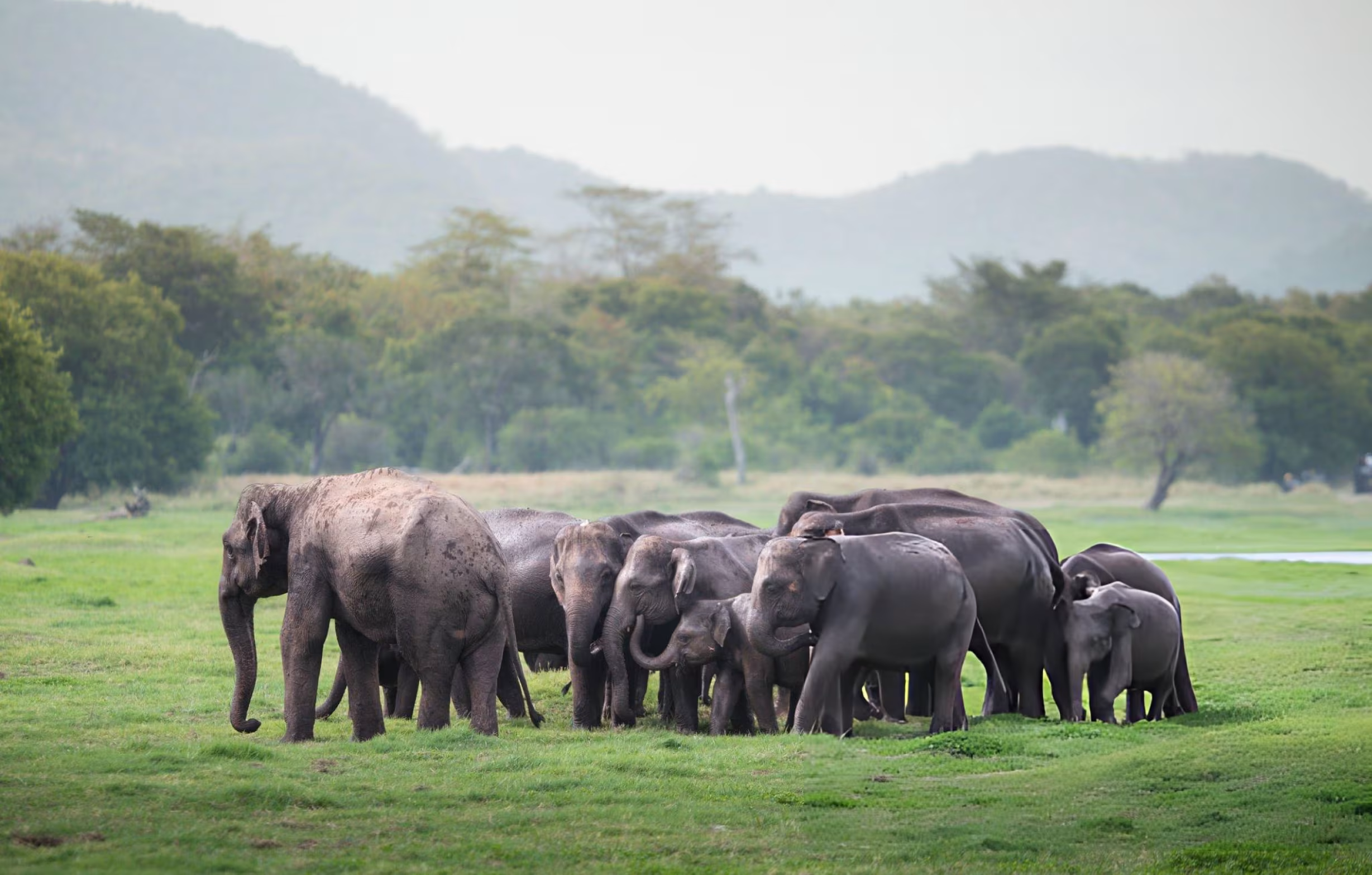
The elephant gathering at Udawalawe National Park stands as one of Sri Lanka's most remarkable wildlife phenomena, offering visitors a virtually guaranteed opportunity to witness dozens—sometimes hundreds—of Asian elephants congregating in their natural habitat. Unlike the seasonal gatherings at Minneriya and Kaudulla National Parks where elephant numbers fluctuate dramatically throughout the year, Udawalawe's unique ecosystem supports a stable resident population of 500-600 elephants that remain within the park boundaries year-round. This remarkable consistency makes Udawalawe the most reliable destination in Sri Lanka—and arguably all of Asia—for experiencing large-scale elephant congregations without depending on precise seasonal timing. The sight of multiple elephant herds gathering around the ancient Udawalawe Reservoir, with mothers tenderly caring for playful calves, massive bulls asserting dominance, and entire family groups bathing, feeding, and socializing together, creates an unforgettable wildlife spectacle that rivals anything found in Africa's famous savanna parks. This comprehensive guide explores everything you need to know about the Udawalawe elephant gathering—from understanding why these magnificent creatures congregate here, to identifying the best viewing locations, observing fascinating herd behaviors, and maximizing your chances of witnessing this extraordinary natural phenomenon during your Sri Lankan wildlife adventure.
Understanding the Udawalawe Elephant Gathering Phenomenon
The Udawalawe elephant gathering differs fundamentally from the famous seasonal congregations at other Sri Lankan parks, and understanding these differences helps visitors appreciate what makes Udawalawe so special. At parks like Minneriya and Kaudulla, the renowned "Gathering" occurs when elephants from surrounding forests migrate to these parks during peak dry season (July-September) as peripheral water sources dry up. These gatherings are spectacular but highly seasonal—visit outside the optimal months and you might see only scattered small groups rather than the massive congregations these parks are famous for.
Udawalawe's year-round reliability stems from its permanent resident elephant population that doesn't follow seasonal migration patterns. These elephants have established their territories entirely within the park boundaries, treating Udawalawe as their permanent home rather than a seasonal refuge. The Udawalawe Reservoir, created in the 1960s for irrigation and hydroelectric purposes, maintains water levels throughout the year, ensuring elephants never need to migrate elsewhere seeking water. This permanent water availability, combined with extensive grassland feeding areas and forest shelter zones, creates a complete ecosystem that meets all elephant needs across all seasons.

Population density at Udawalawe reaches impressive levels—with 500-600 elephants inhabiting 30,821 hectares, the park supports approximately 16-20 elephants per square kilometer in core areas. This concentration rivals or exceeds many famous African elephant populations, yet occurs in a much more compact, easily accessible park where open terrain ensures excellent visibility. The relatively small park size means that wherever elephants are, they're never far from safari routes, virtually guaranteeing encounters during any game drive.
The "gathering" at Udawalawe occurs daily rather than seasonally. Each morning and afternoon, elephant herds converge on the reservoir for drinking and bathing, creating congregation scenes that, while perhaps not reaching the 300+ elephant peak concentrations of Minneriya's legendary August gatherings, consistently deliver 50-150 elephant sightings with remarkable reliability. For visitors with limited time or flexible schedules who can't precisely time visits to coincide with seasonal peaks elsewhere, Udawalawe's dependability makes it the superior choice for guaranteed elephant encounters.
Why Elephants Gather at Udawalawe: The Ecological Foundation
Several interconnected ecological factors create the conditions that support Udawalawe's exceptional elephant population and their daily gathering behaviors.
Permanent Water Source
The Udawalawe Reservoir serves as the fundamental attraction drawing elephants throughout the year. Unlike natural seasonal waterholes that dry up during droughts, this man-made reservoir receives water from the Walawe River and maintains consistent levels managed for irrigation purposes. Elephants require approximately 150-200 liters of water daily, and the reliable reservoir ensures this critical resource remains available regardless of seasonal rainfall patterns.
The reservoir's size and accessibility allow multiple elephant herds to utilize it simultaneously without competition. The extensive shoreline stretches for kilometers, providing ample space for different family groups to drink, bathe, and socialize without interfering with each other. Elephants show remarkable spatial awareness, with different herds often maintaining respectful distances while sharing water resources, though occasionally territorial displays occur between competitive bulls.
Water quality at the reservoir remains generally good despite agricultural runoff concerns in some areas. Elephants demonstrate preferences for certain sections of the reservoir, possibly based on water taste, temperature, depth, or bottom substrate quality. Safari guides who understand these preferences position vehicles in optimal locations for viewing the daily water visits.

Abundant Food Resources
Grassland ecosystems covering large portions of Udawalawe provide elephants with their preferred food source—grass. Asian elephants are primarily grazers, consuming up to 150-200 kilograms of vegetation daily, with grass comprising 50-80% of their diet depending on availability. Udawalawe's extensive grasslands, maintained partly through periodic burning and grazing pressure, offer abundant grazing opportunities year-round.
The reservoir's influence on vegetation creates particularly nutritious feeding zones. As water levels fluctuate seasonally, the reservoir edges expose nutrient-rich mud where fresh grass shoots emerge. These tender young grasses contain higher protein and moisture content than mature dry grasses, making them especially attractive to elephants. You'll frequently observe large congregations feeding intensively along these productive reservoir margins, particularly during dry season months when these fresh shoots contrast with surrounding dried vegetation.
Forest areas along the park periphery provide supplemental browse including leaves, bark, and fruits. While elephants primarily graze in open areas, they retreat to forest shade during hot midday hours, feeding on woody vegetation. This habitat diversity ensures year-round food availability even during extreme dry seasons when grasslands become depleted—elephants can shift feeding strategies, incorporating more browse until rains regenerate grasslands.
Ideal Habitat Structure
Open terrain characterizes much of Udawalawe, contrasting with dense forest habitats many Sri Lankan elephants occupy elsewhere. This openness suits elephant behavioral needs—they're social animals that gather in family groups and use visual communication extensively. Open grasslands facilitate the long-distance visual contact that helps elephant families coordinate movements, locate each other after temporary separations, and monitor for threats.
Thermal regulation benefits from habitat structure mixing open grasslands with scattered tree cover and forest patches. Elephants lack efficient cooling mechanisms—they don't sweat effectively and must rely on behavioral thermoregulation including bathing, dust bathing, ear flapping, and seeking shade. Udawalawe's combination of water access for bathing, open areas for wind cooling, and forest shade for heat refuge creates optimal conditions for managing Sri Lanka's tropical heat.
Low human pressure within park boundaries allows elephants to behave naturally without the stress and conflict that characterizes human-elephant interactions in many parts of Sri Lanka. While human-elephant conflict remains a severe conservation challenge in agricultural areas surrounding the park, within Udawalawe's protected boundaries, elephants can feed, move, and socialize without fear of retaliation for crop raiding or property damage.

Elephant Herd Behavior and Social Structure at Udawalawe
Observing the Udawalawe elephant gathering provides exceptional opportunities to witness complex elephant social behaviors that reveal the sophisticated intelligence and emotional depth of these remarkable animals.
Family Herds and Matriarchal Leadership
Female-led family groups form the foundation of elephant society. These herds typically consist of 8-20 related females spanning multiple generations—grandmothers, mothers, daughters, sisters, and their young offspring. The oldest, most experienced female (the matriarch) leads the herd, making critical decisions about movement routes, feeding locations, water visits, and responses to threats. Her accumulated decades of knowledge about resources, dangers, and seasonal patterns proves invaluable for herd survival.
Matriarchal wisdom becomes visible when you observe herds moving through Udawalawe. The matriarch often walks at the front or center of the group, with other adults surrounding younger, more vulnerable members. When approaching water, the matriarch assesses safety before allowing the herd to proceed—you'll sometimes see her standing alert, trunk raised to scent the air, ears extended to detect sounds, determining whether the coast is clear. Only after her approval does the entire herd move forward to drink and bathe.
Cooperative calf rearing represents one of elephant society's most touching aspects. While mothers maintain primary responsibility for their calves, other herd females ("allomothers") actively participate in childcare. Young females practice maternal behaviors by helping supervise, guide, and protect calves, preparing for their future roles as mothers. You'll frequently observe multiple females surrounding young calves, ensuring they stay safe during the vulnerability of water visits where crocodiles pose potential threats.

Bachelor Groups and Solitary Bulls
Male elephants leave their birth herds upon reaching adolescence (typically 12-15 years old), living either alone or in loose bachelor groups. Unlike the stable family herds, bachelor groups have fluid membership with individuals coming and going. These groups serve social and learning functions—younger males associate with older, more experienced bulls who teach fighting techniques, musth management, and mating strategies through observation and practice sparring.
Dominance hierarchies among males become apparent during gatherings when multiple bulls interact. Larger, older males typically dominate smaller, younger ones through size, experience, and confidence rather than actual fighting. Watch for subtle dominance displays—a dominant bull approaching with head held high and ears spread, while subordinate males yield space, lower their heads, or move away. Serious fights are relatively rare since they carry injury risk; instead, males rely on assessment and posturing to determine hierarchy.
Musth periods create dramatic behavioral changes in mature bulls. During musth (a hormonal condition increasing testosterone levels up to 60 times normal), bulls become highly aggressive, unpredictable, and singularly focused on locating receptive females. Musth bulls display characteristic signs including temporal gland secretions (dark streaking from glands between eye and ear), continuous urine dribbling, and distinctive posture with head held high. Even dominant bulls typically avoid musth males due to their heightened aggression and reduced fear.
Communication and Social Interaction
Vocalizations ranging from subsonic rumbles to trumpeting calls facilitate elephant communication over remarkable distances. Low-frequency rumbles (many below human hearing range) travel several kilometers through ground vibrations that elephants detect through their feet and trunk tips. These calls coordinate herd movements, locate separated individuals, signal alarm, and maintain social bonds between dispersed groups.
Physical contact plays crucial roles in elephant social bonding. Watch for trunk intertwining between closely bonded individuals (greeting behavior strengthening social ties), trunk-to-mouth contact (calves seeking reassurance from mothers), and tusk clashing during play-fighting (young males practicing skills they'll need as adults). The trunk's incredible sensitivity and dexterity makes it simultaneously a tool, weapon, and communication device capable of expressing complex emotions.
Bathing and mud wallowing serve both practical and social functions. While these behaviors provide essential cooling and skin protection (mud blocks sun and repels insects), they also represent important social activities. Family herds bathe together with considerable playfulness—calves splashing, rolling, and climbing on each other while adults supervise and occasionally join the fun. These relaxed water sessions strengthen social bonds and allow stress-free interaction among herd members.

Best Locations for Viewing Elephant Gatherings at Udawalawe
Understanding where elephants concentrate helps maximize your viewing opportunities during Udawalawe safaris.
The Reservoir Shoreline
The main reservoir area represents Udawalawe's premier elephant viewing location, particularly during morning (6:00-9:00 AM) and late afternoon (3:00-6:00 PM) when elephants most actively visit for drinking and bathing. Safari routes circumnavigate much of the reservoir, allowing drivers to position vehicles at optimal vantage points based on real-time elephant locations.
Northern reservoir sections often host the largest gatherings, possibly due to gentler shoreline slopes allowing easier water access for calves and providing extensive shallow areas perfect for bathing. The substrate in these areas may also offer superior mud quality for wallowing. Safari guides monitor these sections closely and position vehicles to observe herds approaching from forest areas, drinking at the water's edge, and engaging in bathing activities.
Southern reservoir areas feature more varied topography with some steeper banks and deeper water close to shore. While these areas see somewhat fewer elephants overall, they often attract solitary bulls and smaller bachelor groups preferring quieter locations away from large family herd concentrations. Photographers sometimes prefer these areas for less crowded compositions focusing on individual elephants or small groups.
Water level variations affect where elephants congregate along the reservoir. During dry season months when levels drop, elephants concentrate at remaining deep water sections. During wet season when the reservoir fills, shoreline access becomes easier across broader areas and elephant distribution spreads more widely. Experienced safari drivers understand these patterns and adjust routes accordingly.

Central Grassland Plains
Open grassland areas between the reservoir and forest zones host actively feeding elephant herds throughout the day. These expansive plains offer unobstructed views allowing you to observe elephants from considerable distances, watching them graze peacefully while moving slowly across the landscape. The open terrain creates spectacular opportunities for landscape-oriented photography showing elephants within their broader habitat context.
Early morning grassland viewing proves particularly productive as elephants emerge from forest areas where they sheltered overnight, spreading across grasslands to feed during cooler morning hours. The soft morning light illuminates elephants beautifully against golden grasses (dry season) or verdant green backgrounds (wet season), creating ideal photography conditions. Multiple herds may be visible simultaneously across the plains, providing opportunities to observe different family groups' behaviors comparatively.
Midday grassland activity typically decreases as heat intensifies and elephants seek shade. However, determined grazers continue feeding throughout the day, and elephants moving between forest shade and water sources often traverse grasslands during these hours. The harsh midday light challenges photographers but creates dramatic high-contrast imagery appealing to some creative approaches.
Forest Edges and Transition Zones
Forest-grassland boundaries attract elephants seeking browse vegetation supplementing their grass-based diets. These transition zones offer diverse food plants including shrubs, small trees, and forest edge vegetation elephants strip for bark, leaves, and branches. The mixed habitat also provides convenient access to both shade (when elephants need cooling) and open feeding areas (when they prefer grazing).
Wildlife concentration at these edges extends beyond elephants—you'll frequently encounter sambar deer, spotted deer, wild boar, and various bird species utilizing these productive habitat interfaces. The vegetation diversity supports richer wildlife communities, making forest edges excellent locations for general wildlife viewing beyond just elephant watching.
Shade utilization becomes critical during hot months (March-April) when midday temperatures exceed 35°C (95°F). Elephants retreat to forest shade during peak heat, standing quietly under tree cover while slowly browsing. Safari routes along forest edges allow observation of these resting elephants, though viewing is less spectacular than active feeding or bathing behaviors seen in more open areas.

Daily Patterns: When Elephant Gatherings Peak
Understanding daily activity rhythms helps you optimize safari timing for maximum elephant viewing.
Morning Gathering (6:00 AM - 10:00 AM)
Dawn activity begins as elephants emerge from overnight forest shelters and move toward feeding and water areas. Family herds often travel together during these morning movements, creating impressive processions of 15-30 elephants walking in coordinated lines. The cooler morning temperatures encourage active behavior—feeding intensifies, calves play energetically, and social interactions occur frequently as herds encounter each other.
Reservoir visits peak during mid-morning (7:30-9:30 AM) when numerous herds converge for drinking after several hours of feeding. This period often produces the most spectacular gathering scenes with 50-100+ elephants visible simultaneously around the reservoir. Watch for bathing behavior beginning as temperatures rise—elephants wade into deeper water, spray themselves using their trunks, and roll luxuriously in cooling mud.
Photography opportunities during morning hours benefit from soft, warm light creating flattering illumination and long shadows adding depth. The golden hour (approximately 6:00-7:00 AM) produces particularly beautiful results with elephants backlit or side-lit by low-angle sun. Morning mist occasionally lingers over the reservoir early in the dry season, adding atmospheric quality to images.
Midday Patterns (10:00 AM - 2:00 PM)
Heat avoidance drives behavior during these hottest hours as elephants seek shade and minimize energy expenditure. Most herds retreat to forest areas, standing quietly under tree cover while occasionally browsing. Activity levels drop significantly—you're less likely to see large active gatherings during this period as elephants prioritize thermal regulation over feeding and socializing.
Reservoir bathing continues sporadically through midday despite reduced overall activity. Some elephants remain at water throughout the day, particularly during hottest months, repeatedly bathing to maintain comfortable body temperatures. Bulls especially may spend extended periods in the water, submerged to chest depth while drinking, spraying, and wallowing.
Safari considerations during midday hours include harsh lighting conditions challenging for photography, reduced elephant activity making viewing less dynamic and engaging, and extreme heat affecting visitor comfort. Many safari operators suggest morning-only or late-afternoon-only half-day safaris rather than full-day excursions spanning uncomfortable midday hours, particularly during March-April peak heat.

Afternoon Gathering (3:00 PM - 6:00 PM)
Afternoon emergence begins around 3:00-3:30 PM as temperatures start declining and elephants leave forest shade to resume feeding. Herds move from forest areas toward grasslands and the reservoir, often traveling the same routes used during morning movements. The predictability of these travel routes allows experienced safari drivers to position vehicles along probable paths for excellent viewing of approaching herds.
Peak evening gathering occurs between 4:30-6:00 PM when reservoir visits intensify as elephants drink before settling into overnight forest areas. This period rivals morning hours for spectacular gathering scenes with numerous herds converging simultaneously. The late afternoon bathing sessions often appear particularly playful—calves splash enthusiastically, adults interact socially, and the relaxed atmosphere creates wonderful behavioral viewing.
Sunset photography represents afternoon safaris' greatest advantage. The golden hour (approximately 5:00-6:00 PM) bathes elephants in warm, glowing light perfect for dramatic imagery. Silhouettes against colorful sunset skies create iconic safari photographs, while the warm tones enhance elephants' skin texture and the surrounding landscape. Many photographers specifically choose afternoon safaris for these magical sunset opportunities.
Evening departure sees elephants gradually leaving the reservoir as darkness approaches (safaris must exit the park by official closing time around 6:00-6:30 PM). You'll observe herds walking purposefully toward forest areas where they'll spend the night, often in long single-file lines that create striking images when silhouetted against the fading light.
Seasonal Variations in Gathering Intensity
While Udawalawe provides year-round elephant viewing, subtle seasonal patterns influence gathering size and behavior.
Dry Season Concentrations (May - September)
Water source contraction during dry months increases elephant concentration around the Udawalawe Reservoir as it becomes increasingly critical as the only reliable water source. While the reservoir maintains water year-round, its levels drop during dry season, and peripheral forest water sources dry completely. This dynamic pushes maximum elephant numbers toward the main reservoir area.
Gathering size during peak dry season (August-September particularly) can rival the famous Minneriya gatherings with 100-150+ elephants visible simultaneously around the reservoir. While not reaching Minneriya's peak concentrations of 300+ animals, Udawalawe's dry season gatherings prove spectacular and far more reliable than Minneriya's highly seasonal phenomenon.
Behavioral changes during dry months include increased feeding time along reservoir edges where fresh grass continues growing despite overall landscape drying, more frequent water visits throughout the day as heat intensifies, and potentially increased competition between herds for prime feeding and water access areas (though serious conflict remains rare).

Wet Season Distribution (October - April)
Water availability increases during wet months as rainfall creates temporary pools, wetlands expand, and forest water sources replenish. This wider water distribution allows elephants to spread more broadly across the park rather than concentrating exclusively around the main reservoir. However, elephants continue regularly visiting the reservoir due to its size, permanence, and the superior bathing opportunities it provides compared to smaller forest pools.
Herd distribution becomes less concentrated with family groups utilizing broader territories. You'll still encounter numerous elephants during wet season safaris, but they're more scattered across varied locations rather than massed at single gathering sites. This distribution can actually enhance viewing quality—smaller groups allow closer observation of family dynamics and individual behaviors without the chaos of massive congregations.
Vegetation impacts transform the park during wet season with grasses turning vibrant green, fresh shoots emerging everywhere, and overall food abundance increasing dramatically. Elephants feed more widely across grasslands rather than focusing on limited fresh growth areas around receding water bodies. The lush landscape creates beautiful photographic backgrounds contrasting with dry season's golden tones.
Calving season coincides with late wet season (December-February particularly) when food abundance supports the nutritional demands of pregnancy and lactation. You'll encounter adorable baby elephants during these months, often just weeks or months old. Watching newborn calves wobble on uncertain legs, attempt to control their trunks, and stay close to protective mothers provides heartwarming viewing experiences.
Photography Tips for Capturing Elephant Gatherings
Photographing Udawalawe's elephant gatherings requires understanding both technical camera work and elephant behavior.
Essential Equipment
Telephoto lenses prove critical for elephant photography, with 200-400mm (or longer) focal lengths allowing frame-filling shots while maintaining respectful distances. A 100-400mm or 150-600mm zoom provides versatility for various compositions—tight portraits of individual elephants, medium shots showing social interactions, and wider views capturing multiple animals and landscape context.
Camera bodies capable of reasonable low-light performance (ISO 1600-3200 without excessive noise) extend shooting opportunities during early morning and late afternoon when light levels drop but elephant activity peaks. Fast continuous shooting speeds (6+ frames per second) help capture behavioral moments and action—bathing splashes, play-fighting, trumpeting displays—that happen quickly and unpredictably.
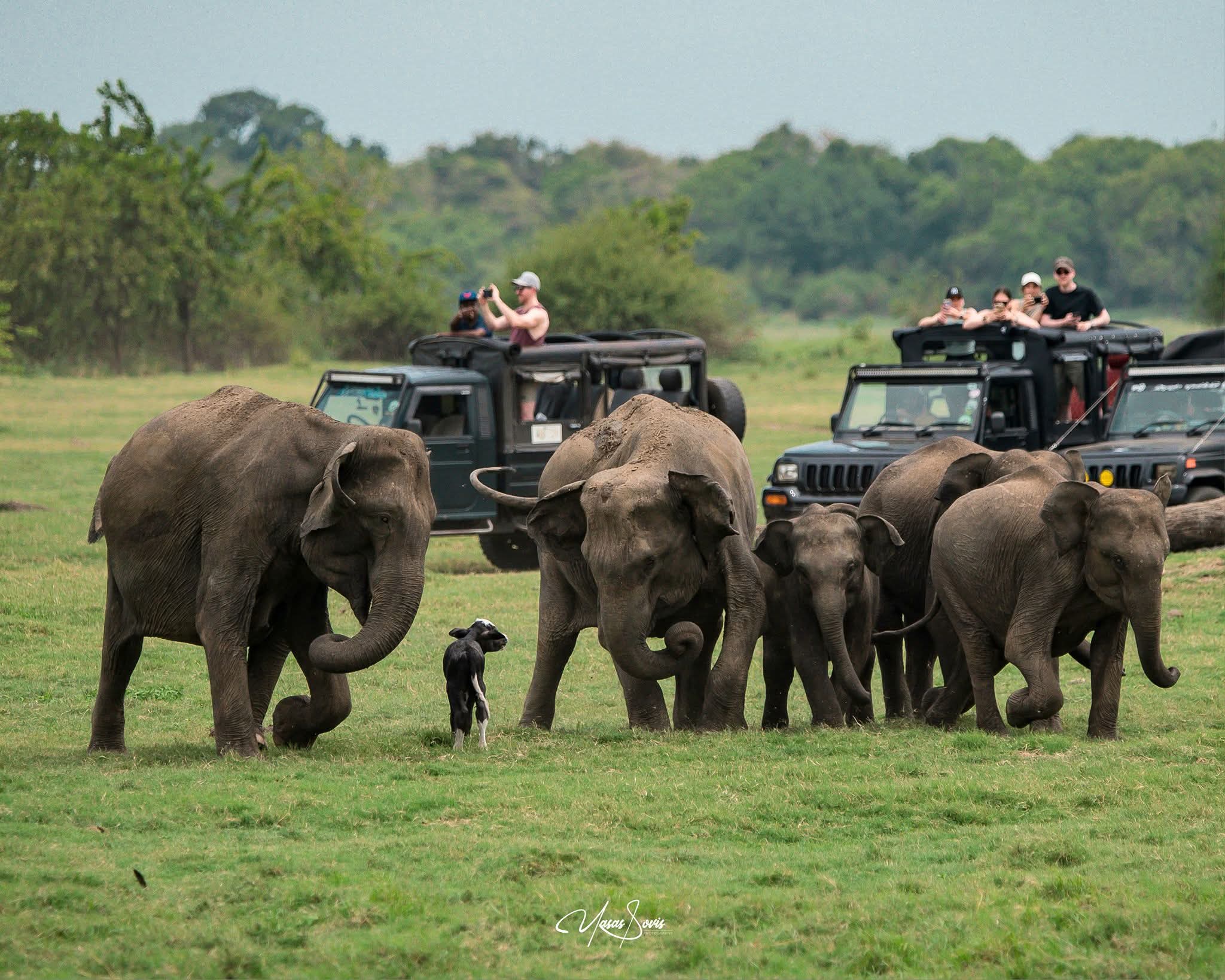
Support options improve sharpness when shooting from safari jeeps. Beanbags resting on window frames or roof edges provide stable lens support absorbing vehicle vibrations. Many safari jeeps have pop-up roof hatches allowing standing positions—shooting from above reduces foreground clutter and provides different perspectives, though stability becomes more challenging.

Camera Settings for Elephant Photography
Shutter speed requirements depend on subject activity. For stationary or slowly moving elephants, 1/250s suffices for sharp images. For active behavior—bathing, playing, walking—increase to 1/500s or faster to freeze motion. Very fast action like dust bathing or vigorous play may require 1/1000s+. Remember that safari jeep vibrations necessitate faster speeds than if shooting from stable ground.
Aperture selection balances depth of field against light gathering. For individual elephant portraits, f/5.6-f/8 provides sufficient depth to keep the entire head sharp while blurring backgrounds beautifully. For herd shots showing multiple elephants, stop down to f/11 or narrower to keep multiple animals at varying distances all acceptably sharp. Wide apertures (f/4-f/5.6) work beautifully for isolating subjects against blurred backgrounds.
ISO management should be adjusted to maintain proper exposure while using optimal shutter speed and aperture combinations. During bright midday, ISO 200-400 typically suffices. During golden hours, increase to ISO 800-1600 to maintain fast enough shutter speeds. Don't fear higher ISOs during spectacular lighting or behavioral moments—a slightly noisy but sharp, well-composed action shot beats a blurry low-ISO image.
Autofocus modes should utilize continuous AF (AI Servo/AF-C) to track moving elephants. Configure focus point selection for flexibility—single point for precise control on stationary subjects, zone or expanded point for moving elephants. Back-button focus separates focusing from shutter release, providing more control and preventing inadvertent refocusing during critical moments.
Composition Techniques
Eye-level shooting creates more engaging, intimate images than looking down from tall safari vehicles. Lower your camera position to shoot closer to elephant eye level, creating more flattering perspectives and stronger connections between subjects and viewers. When photographing calves, get even lower to emphasize their small size and vulnerable appearance.
Background awareness dramatically affects image quality. Cluttered backgrounds with distracting branches, other vehicles, or random elements ruin otherwise excellent elephant photos. Position your vehicle (by communicating with your driver) to achieve clean backgrounds—blue sky, uniform grassland, or soft-focused forest greenery. Patience often yields better backgrounds as elephants move relative to background elements.
Behavioral moments create the most memorable images. Rather than collecting static elephant portraits, wait for interaction, expression, and action—mothers touching calves tenderly with their trunks, youngsters play-fighting, adults bathing enthusiastically. These behavioral captures tell stories and convey the intelligence and emotional richness of elephant society.
Herd dynamics can be captured by zooming out to show multiple elephants in relationship—family groups traveling in coordinated lines, adults surrounding and protecting young, matriarchs leading from the front. These wider compositions provide context and scale while illustrating elephant social structure.

Lighting Considerations
Golden hour mastery separates good elephant photos from exceptional ones. The warm, directional light during the hour after sunrise and before sunset creates magical illumination—rich colors, long shadows, rim lighting on elephants, and overall atmospheric quality. Plan safari timing to maximize golden hour opportunities.
Harsh midday light creates challenges with extreme contrast, deep dark shadows, and blown highlights on elephants' lighter skin areas. If shooting midday, look for elephants in partial shade or overcast conditions. Slight underexposure (-.3 to -.7 EV) helps preserve highlight detail in bright skin areas, recoverable in post-processing.
Backlighting can create stunning silhouettes and rim-lit subjects. Position yourself so elephants stand between your camera and the sun, particularly during golden hours. Silhouettes work beautifully against colorful sunrise/sunset skies, while rim lighting creates glowing outlines around elephants' bodies and particularly their ears.
Overcast conditions during wet season provide soft, even lighting that can actually produce beautiful results. The diffused light reduces harsh contrast, creates subtle detail in shadows and highlights, and emphasizes rich colors in greenery. Don't dismiss overcast days as inferior photography conditions—they offer different opportunities requiring different approaches.
Conservation Context: Protecting Udawalawe's Elephant Population
Understanding the conservation challenges facing Udawalawe's elephants adds meaningful context to your gathering observations.
Human-Elephant Conflict
Agricultural expansion surrounding Udawalawe creates severe conservation challenges as elephant territories overlap increasingly with human settlements and farmland. Elephants naturally range across larger areas than the park contains, and when they venture outside protected boundaries, crop raiding conflicts arise. Farmers lose livelihoods when elephants destroy rice paddies, vegetable gardens, and fruit crops, leading to retaliation through chasing, harassment, and sometimes poisoning or shooting.
Electric fencing around much of Udawalawe's boundary attempts to keep elephants within the park, but determined elephants sometimes breach or circumnavigate fencing. Young males particularly, driven by wanderlust and food-seeking behavior, venture into agricultural areas despite barriers. The balance between protecting elephants and supporting local communities who bear the costs of living alongside dangerous megafauna represents one of conservation's thorniest challenges.
Community-based solutions including crop-guarding programs, compensation schemes for crop losses, and alternative livelihood development aim to reduce conflict. Some initiatives help farmers switch from elephant-attracting crops (rice, bananas) to elephant-resistant alternatives (chili, citrus). Others establish community early-warning systems to alert farmers when elephants approach, allowing preventive action rather than after-the-fact retaliation.

Tourism's Conservation Role
Economic value generated by elephant-focused tourism provides powerful incentives for protecting Udawalawe's elephant population. Safari tourism creates jobs for drivers, guides, hotel staff, and ancillary service providers, channeling money into local communities. When elephants generate more economic value alive than dead or displaced, conservation gains local support that's otherwise difficult to achieve.
Park entrance fees directly fund conservation by supporting ranger salaries, infrastructure maintenance, anti-poaching patrols, and habitat management. While the fee structure could potentially be optimized to generate more revenue, the current system does channel meaningful financial resources toward protection. Your safari booking contributes directly to conservation funding.
Education and awareness result from tourism experiences that create emotional connections between visitors and elephants. People who've witnessed Udawalawe's elephant gatherings become advocates for elephant conservation, supporting protection efforts through donations, political pressure, and consciousness-raising within their networks. The ripple effects of transformative wildlife experiences extend far beyond individual park visits.
Responsible Viewing Practices
Distance maintenance protects both elephants and visitors. Approaching too closely stresses elephants and potentially provokes defensive aggression. Bulls in musth or mothers with young calves prove particularly unpredictable and dangerous when threatened. Ethical safari operators maintain minimum approach distances (typically 25-30 meters), never pursuing or harassing elephants for photography opportunities.
Behavioral awareness helps visitors recognize elephant stress signals—ears pulled back tightly against head, trunk held in S-curve, head shaking, trumpeting, or mock charges. If elephants display these behaviors, your vehicle is too close or causing disturbance. Skilled drivers recognize these signals immediately and increase distance, protecting both elephants and safari participants.
Supporting ethical operators by choosing safari companies committed to responsible tourism practices, avoiding those that harass wildlife or violate park regulations, and reporting unethical behavior helps maintain high standards. Research operators before booking—read reviews specifically mentioning their wildlife ethics, ask questions about their approach distance policies, and select companies that prioritize animal welfare over extreme close-up photography opportunities.
Comparing Udawalawe to Other Sri Lankan Elephant Gatherings
Understanding how Udawalawe compares to other famous Sri Lankan elephant destinations helps you select the best park for your priorities.
Udawalawe vs. Minneriya/Kaudulla
Seasonality represents the fundamental difference. Minneriya and Kaudulla host spectacular seasonal gatherings (July-September peak) when 200-300+ elephants congregate as surrounding forests dry. However, visit outside this narrow window and you might see only scattered small groups. Udawalawe's resident population provides year-round reliability—you'll see substantial elephant numbers (50-150+) regardless of visit month.
Viewing quality differs between concentrated seasonal gatherings versus consistent year-round presence. Minneriya at peak (August particularly) can present 300+ elephants visible simultaneously—a staggering spectacle unmatched anywhere else in Asia. However, this spectacle comes with massive tourist crowds and limited booking availability. Udawalawe rarely hits these peak numbers but delivers consistently impressive gatherings (50-150 elephants) with better crowd management and easier booking.
Accessibility favors Udawalawe for travelers with flexible schedules. If you can visit Sri Lanka only during December or March, Minneriya/Kaudulla may disappoint with scattered elephant sightings. Udawalawe guarantees excellent viewing whenever you come. For visitors who can precisely time travel to coincide with July-September, experiencing both Minneriya and Udawalawe provides contrasting perspectives on elephant gatherings.

Udawalawe vs. Yala
Species diversity favors Yala, which hosts leopards, sloth bears, crocodiles, and exceptional bird diversity beyond its elephant population. Yala appeals to visitors seeking varied wildlife beyond just elephants. However, Yala's elephants are less concentrated and less reliably viewed than Udawalawe's gathering-focused population.
Elephant concentrations strongly favor Udawalawe. While Yala contains elephants, they're more scattered across the larger park, and viewing them involves more luck. If elephants are your primary interest, Udawalawe delivers superior and more predictable encounters. Yala excels for visitors wanting diverse wildlife including the chance (though not guarantee) of leopard sightings.
Crowding issues affect Yala severely during peak season when dozens of jeeps crowd around leopard sightings or block roads at wildlife viewing spots. Udawalawe, while busy during peak months, manages crowds better due to larger territory, multiple viewing areas, and elephant distribution preventing severe jeep congestion at single locations.
Planning Your Udawalawe Elephant Gathering Experience
Maximizing your elephant gathering experience requires thoughtful planning around several key factors.
Optimal Safari Timing
Morning safaris (6:00-10:00 AM) provide the most active elephant viewing with herds emerging from overnight forest areas, feeding intensively during cool morning hours, and converging on the reservoir for drinking and bathing. The soft morning light creates beautiful photography conditions, and cooler temperatures ensure comfortable safari experiences.
Afternoon safaris (3:00-6:00 PM) rival mornings for elephant activity, particularly during the last 2 hours when herds converge at the reservoir before retiring to forest areas for the night. The golden hour photography opportunities during late afternoon make this timing ideal for photographers prioritizing dramatic lighting over potentially maximizing elephant numbers.
Full-day safaris allow observation of elephant behavior changes throughout the day—morning activity, midday shade-seeking, afternoon re-emergence. However, the long hours in hot conditions (particularly March-April) can prove exhausting. Half-day safaris (morning or afternoon) typically provide optimal experiences balancing wildlife viewing with physical comfort.
Booking Considerations
Advance reservations during peak tourist season (December-March, July-August) ensure safari and accommodation availability. Book 2-4 weeks ahead for popular properties and preferred safari times. Shoulder seasons (April-June, September-November) offer more flexibility with successful bookings possible just days or even the day before departure.
Accommodation proximity to park gates minimizes early morning travel for dawn safari departures. Properties within 10 kilometers of the main entrance allow comfortable 5:30-5:45 AM departures for 6:00 AM safaris, maximizing valuable morning viewing time. More distant accommodations require earlier wake-up calls and longer travel cutting into safari time.
Safari operator selection significantly impacts experience quality. Research operators through reviews emphasizing guide knowledge, elephant behavior expertise, and ethical viewing practices. Experienced naturalist guides enhance the experience immeasurably by explaining behaviors, identifying individual elephants, and sharing conservation context that transforms safari from simple wildlife viewing into educational experience.

Beyond the Gathering: Other Udawalawe Wildlife Experiences
While elephants dominate Udawalawe safaris, the park hosts diverse wildlife enriching your overall experience.
Mammal Diversity
Water buffalo herds frequently congregate around wetland areas, sometimes numbering 50-100 individuals. These massive bovines create impressive sights when gathered densely, particularly when wallowing in mud pools. Bulls can be aggressive during breeding season—maintain safe distances and observe from vehicles.
Deer species including spotted deer (chital) and sambar deer graze openly across grasslands, often mixing with elephant herds. Spotted deer's distinctive white spots and lyre-shaped antlers make them photogenic subjects, while larger sambar deer—particularly impressive stags with heavy antlers—command respect.
Smaller mammals spotted occasionally include golden jackals (alone or in pairs, particularly near water at dawn and dusk), wild boar (rooting in muddy areas), mongoose species (darting across roads or hunting in grasslands), and rarely, leopards (Udawalawe contains leopards but sightings are uncommon due to low density and the cats' nocturnal habits).
Avian Abundance
Water birds concentrate around the reservoir in spectacular numbers. Painted storks nest in large colonies creating photogenic scenes with hundreds of birds in single trees. Spot-billed pelicans, Asian openbills, and various egret species feed in shallow wetlands. Black-headed ibis, purple herons, and lesser adjutants add to the wetland bird diversity.
Raptors soar overhead throughout safaris. White-bellied sea eagles hunt around the reservoir, crested serpent eagles perch in tall trees scanning for prey, and various kite species circle thermals. These impressive birds of prey create excellent photography subjects, particularly when perched prominently or diving to catch fish.
Endemic species including Sri Lankan grey hornbill, Ceylon junglefowl, and yellow-fronted barbet reward birdwatchers seeking country-specific species. The dry zone habitat supports different bird communities than Sri Lanka's wet zone forests, creating unique birdwatching opportunities.
Reptiles and Other Wildlife
Crocodiles bask frequently on mudbanks and reservoir edges, particularly during dry season when exposed shorelines provide ideal basking sites. These impressive reptiles can exceed 4 meters in length. Observe from safe distances—saltwater crocodiles are powerful predators commanding respect.
Water monitors hunt actively around wetland areas, swimming powerfully and climbing trees with surprising agility. These large lizards (up to 2 meters) are spectacular to observe and photograph, particularly when backlit by morning or afternoon sun highlighting their scales.
Star tortoises occasionally cross roads during early morning or late afternoon, particularly after rains. These endangered tortoises with beautiful geometric shell patterns are protected by law—never attempt to touch or move them.

Final Thoughts: Experience Sri Lanka's Most Reliable Elephant Gathering
The elephant gathering at Udawalawe National Park represents one of Sri Lanka's most accessible and reliable wildlife spectacles, offering virtually guaranteed close encounters with these magnificent animals regardless of when you visit. While other parks may occasionally host larger seasonal congregations, none match Udawalawe's consistency and dependability in delivering impressive elephant viewing throughout all twelve months of the year.
Whether you witness 50 elephants or 150, whether visiting during verdant wet season or golden dry season, the experience of watching these intelligent, social, emotional animals gathering to drink, bathe, feed, and socialize in their natural habitat creates memories that last lifetimes. The sight of a tender mother guiding her wobbly newborn calf, the power of a massive bull asserting dominance, the playfulness of adolescents wrestling in the reservoir, and the wisdom of an ancient matriarch leading her family across open grasslands—these moments connect us profoundly with the natural world and inspire commitment to protecting these irreplaceable creatures.
Plan your Udawalawe safari with confidence knowing that the elephants will be there waiting, ready to share their world with visitors willing to observe respectfully and appreciate the privilege of witnessing one of nature's most remarkable gatherings. Book your safari, prepare your camera, open your heart to wonder, and prepare for an encounter with the magnificent elephants of Udawalawe that will change how you see the natural world forever.